Ants in Phoenix are almost always a moisture-and-entry problem before they are a bug problem. In Arcadia, flood irrigation and mature citrus keep soil damp year-round, and Argentine and rover ants build satellite…
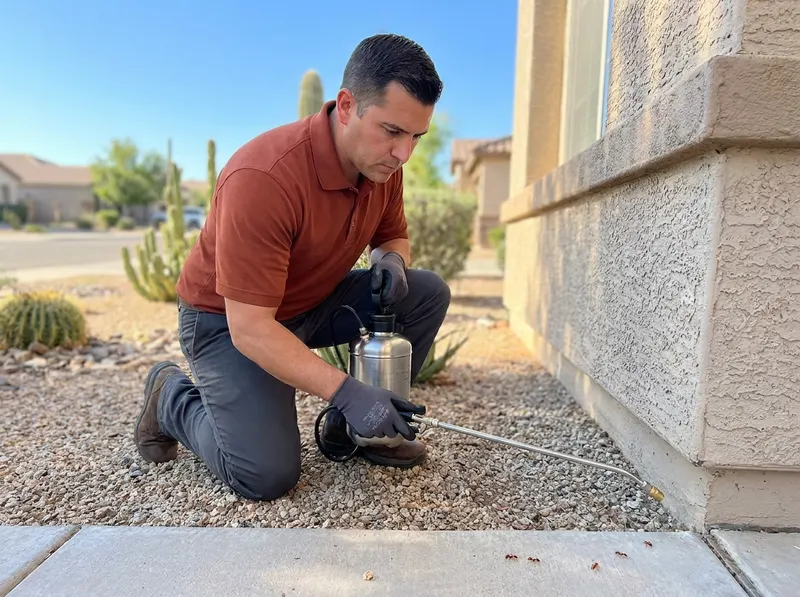
Ants in Phoenix are almost always a moisture-and-entry problem before they are a bug problem. In Arcadia, flood irrigation and mature citrus keep soil damp year-round, and Argentine and rover ants build satellite colonies under the mulch line, then follow drip tubing and weep screeds straight into kitchens. In Laveen and Desert Ridge, newer stucco construction gives ants an easy vertical highway behind the weep screed at the base of the wall. In the Willo Historic District, Encanto-Palmcroft, and Coronado Historic District, the pattern is different again: older slabs with settlement cracks, cast-iron and clay plumbing penetrations, and mature ash and elm roots that let pavement ants surface right at the interior threshold. Treating only where the ants are visible is why trails come back in two weeks.
The first monsoon storms change everything. Heavy rain saturates soil and floods shallow colonies, and ants move upslope and indoors within a day or two — which is why call volume spikes across Maryvale, Moon Valley, and Ahwatukee Foothills in July and August. Homes at the desert edge near South Mountain Park and Preserve or below Piestewa Peak in the Phoenix Mountains Preserve also get pressure from open desert: southern fire ants and desert harvester ants push in from undisturbed ground toward irrigated turf and pet water bowls. Ahwatukee back yards that share a wall with the preserve boundary see this most.
On decision-fit: baiting is the right call when you have an active indoor trail and cannot find the nest, because foraging workers carry the bait back and the colony is reduced from the inside out. Baiting is slower — expect several days to visible decline, not minutes — and it requires holding off on spraying the trail, which frustrates homeowners who want the line of ants gone tonight. A perimeter treatment is the right call when the colony is clearly outside and the goal is to stop entry: block-wall bases, weep screeds, hose bibs, irrigation valve boxes, and door thresholds. Most Phoenix ant jobs use both, in that order. Fire ant mounds in turf are handled differently again — direct mound treatment, because those colonies are a sting risk to kids and dogs, not a kitchen nuisance. Carpenter ants coming out of an old patio beam or a fence post signal wood moisture and get a structural look, not just a bait station.
We write down what we find. If ants are entering through a gap under a sliding door track in a Roosevelt Row loft or through a cracked weep screed on a Laveen new build, that goes in the notes with a recommendation, because a sealed perimeter holds longer than any product alone. Ongoing quarterly service makes sense for homes with flood irrigation, dense landscaping, or a shared block-wall alley in Maryvale, where re-invasion pressure never really stops. Homes with one seasonal trail often need a single visit and better sealing instead. Ask any Phoenix pest company — including us — for their Arizona pesticide applicator license number before product touches your property. That is a fair question and a straight answer is the minimum.
Every job gets a firm, written price after a free on-site visit.
Tell us about your ant control job in Phoenix and we'll send a clear, written quote — usually the same day.
 Nestleap Pest Control Service