Crickets do not live in your house by choice — they live in the wet, shaded, cluttered edges of a Phoenix yard and come inside when the ground dries out or the temperature swings. That means the fix is almost always…
Crickets do not live in your house by choice — they live in the wet, shaded, cluttered edges of a Phoenix yard and come inside when the ground dries out or the temperature swings. That means the fix is almost always outdoors. Irrigation valve boxes, drip-line edges, thick mulch, woodpiles, artificial turf seams, and the gap at the bottom of a roll-up garage door are the four or five places crickets concentrate on a typical Maricopa County lot. In Arcadia, mature citrus and flood-irrigated lawns hold moisture long after the rest of the city bakes, and crickets stack up along the wet grass line before hopping toward the patio doors. In Laveen and Desert Ridge, the pattern is different: newer stucco homes with tight block-wall alleys and bright coach lights, where crickets gather under the fixtures at dusk and then work along the wall into weep screeds. Along the desert edge in Ahwatukee Foothills, near South Mountain Park and Preserve, field crickets move in from open desert washes after a storm. Older properties in Willo Historic District, Coronado Historic District, and Encanto-Palmcroft have their own weak point — worn door sweeps and settled thresholds on 1920s-1940s homes give crickets a straight path into the entry hall and the laundry room.
Decide between a one-time cricket service and an ongoing perimeter plan based on how the crickets are getting in. A one-time treatment fits a short, obvious spike — one wet spot, one storm, chirping in the garage for a week, no history of the problem returning. It knocks the population down and buys you a quiet house. An ongoing perimeter plan fits recurring pressure: irrigated turf, heavy landscape lighting, block walls on two or three sides, or a house that had crickets last August and the August before. The trade-off is honest. One-time is cheaper today and does nothing about next month's hatch or the next monsoon push. Recurring costs more over a year but keeps the treated band on the foundation intact through the season when crickets, ants, and scorpions all move at once. If you are seeing crickets in the garage and a scorpion under a black light in the same week, the recurring option is the one that addresses both, because removing the cricket population removes the scorpion's dinner.
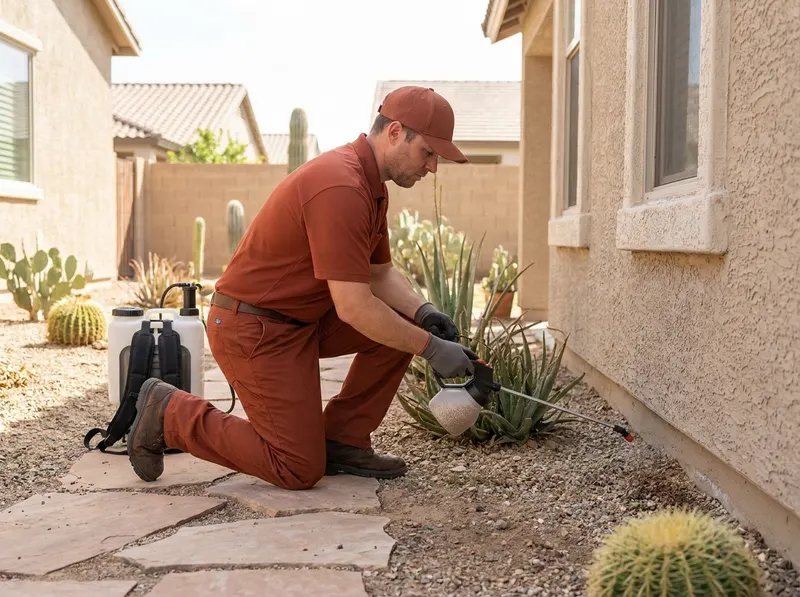
What we do not do is spray the baseboards and call it finished. Interior fogging kills the crickets you can see and leaves the harborage untouched, which is why hose-end products from the hardware store usually buy about ten days. Real cricket control is treatment plus subtraction: pull mulch back from the stem wall, fix the leaking valve box, swap a white porch bulb for a warm-tone or amber fixture so it stops advertising your front door to every cricket within a block, and seal the door sweep and garage threshold so the survivors have nowhere to walk. On the treatment side, exterior perimeter and crack-and-crevice applications go where crickets shelter — wall bases, weep screeds, expansion joints, utility penetrations, and the shaded side of the block wall. All pesticide applications are performed by licensed applicators in accordance with Arizona regulations, and the product and target pest used at your property are documented for you.
Timing matters in this metro. Cricket calls climb from late June through September as monsoon humidity and rain pull populations up out of the desert and out of irrigated yards, then again in the first cool weeks of fall when crickets seek warm slabs and garages. Treating before a storm cycle is easier than chasing crickets after one. If you are in Moon Valley, Maryvale, Roosevelt Row, or anywhere else in the Phoenix service area and the chirping has already started, call (520) 677-4067 and we will schedule the walk-through. Sealed perimeter. Pests stay outside.
Every job gets a firm, written price after a free on-site visit.
Tell us about your cricket control job in Phoenix and we'll send a clear, written quote — usually the same day.
 Nestleap Pest Control Service