Roof rats are climbers, not diggers, so almost every Phoenix infestation starts above the ground floor. They travel citrus canopies, palm skirts, oleander hedges, block walls, and utility lines, then enter at a…
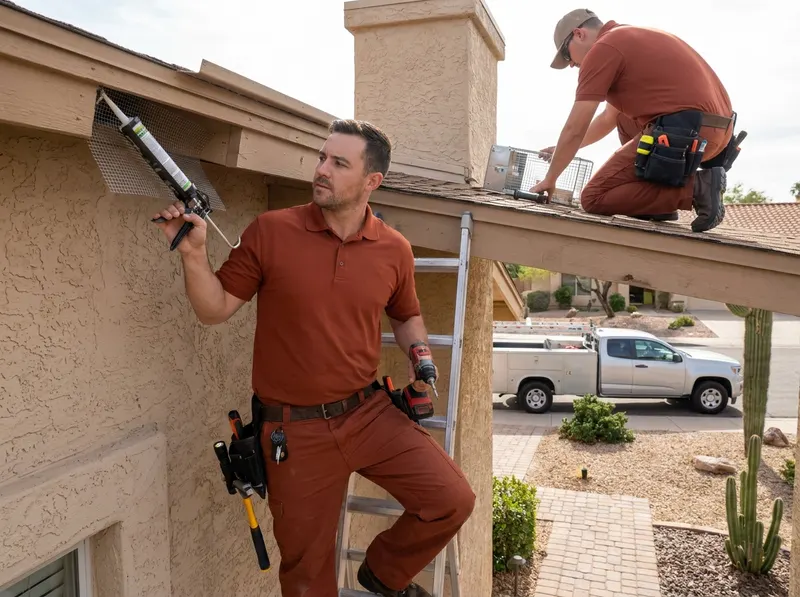
Roof rats are climbers, not diggers, so almost every Phoenix infestation starts above the ground floor. They travel citrus canopies, palm skirts, oleander hedges, block walls, and utility lines, then enter at a tile-roof eave gap, an unscreened gable vent, a loose fascia board, or the gap around a plumbing vent stack. Roof rats have been established in central Phoenix neighborhoods since the early 2000s, and the pattern still holds: Arcadia's mature citrus and flood-irrigated yards, the tall palms and dense hedges around Encanto-Palmcroft and Moon Valley, and the 1920s-to-1940s bungalows in Willo Historic District and Coronado Historic District where original gable vents and shallow attics give rats an easy door. Newer stucco-and-tile builds in Desert Ridge and Laveen are not exempt — the gap under the first course of roof tile is a standard entry point, and so are the weep and vent penetrations along the back of the house.
The decision most Phoenix homeowners face is trapping-only versus trapping plus exclusion. Trapping-only makes sense in a rental turnover, a detached garage, or when one rat wandered in through a propped door — it is cheaper and it can be finished in two or three visits. Trapping without exclusion is a rental, not a fix, because the runway that brought the first rat in is untouched. Full exclusion costs more upfront and takes ladder work, but it converts your roof-line from an open door into a wall. The trade-off is money now versus a repeating callback cycle every fall. We also do not place rodenticide in attics or wall voids on these jobs: a poisoned rat dies where you cannot reach it, and a dead rat in a Phoenix attic in June creates an odor and fly problem worse than the original noise. Snap traps let us confirm the count and know when the attic is actually empty.
Timing matters here more than in most metros. Roof rat pressure climbs from late fall through spring while citrus ripens across Arcadia, Ahwatukee Foothills, and older Maryvale lots, then attic temperatures push past anything comfortable in summer. Sealing work is easiest to complete before June, when roof tile and asphalt are safe to walk and attic crawls are survivable. Homeowner-side work helps and we will tell you exactly what to do: pick fruit off the ground, cut tree and palm limbs back several feet from the roof, trim oleander away from the block wall, and stop leaving pet food or bird seed on the patio overnight. Maricopa County publishes similar guidance for roof rats, and it works — but only alongside sealing, because a hungry rat will still nest in a cool attic near Papago Park or the South Mountain foothills whether or not the yard is clean.
One fair question on any Phoenix rodent quote: who is standing on your roof. Arizona requires pesticide applicators to be licensed through the Office of Pest Management, so ask for a license number on any written quote before work starts. Ask what "exclusion" includes, how many follow-up visits are in the price, and whether the entry points are documented. We give that in writing before anyone opens a trap. Sealed perimeter. Pests stay outside.
Every job gets a firm, written price after a free on-site visit.
Tell us about your roof rat trapping & exclusion job in Phoenix and we'll send a clear, written quote — usually the same day.
 Nestleap Pest Control Service