Phoenix soil conditions decide how a subterranean termite job gets built. In Arcadia, flood irrigation and mature citrus keep the soil under and around the foundation damp for weeks at a stretch, and desert…
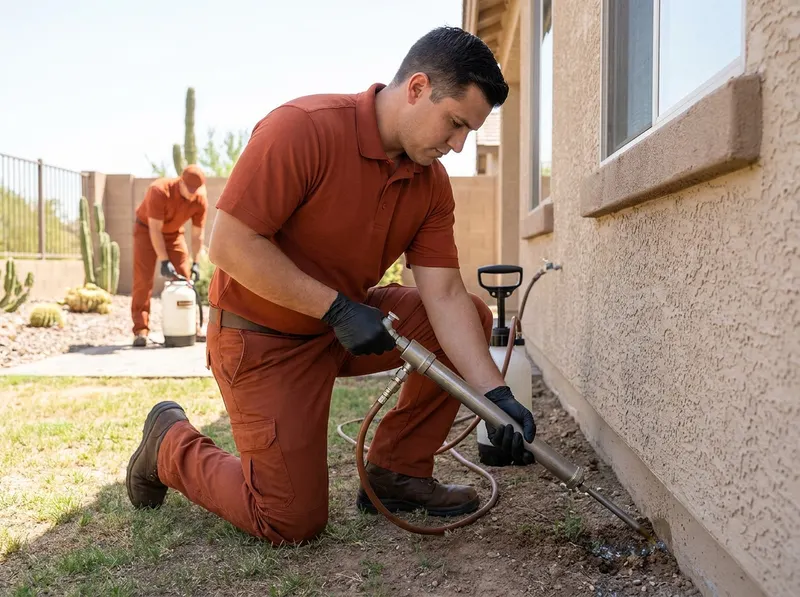
Phoenix soil conditions decide how a subterranean termite job gets built. In Arcadia, flood irrigation and mature citrus keep the soil under and around the foundation damp for weeks at a stretch, and desert subterranean termites follow that moisture straight to the structure — those homes often need the irrigated side of the lot treated more heavily than the dry side. The 1920s-1940s houses in Willo Historic District, Coronado Historic District, and Encanto-Palmcroft bring a different problem: stem walls, crawl areas, deep sub-slab plumbing, and decades of added patios and additions, which means more entry points and more careful drilling. Newer stucco developments in Laveen and Desert Ridge are frequently built on post-tension slabs, so drilling a post-tension slab requires scanning and locating cables first — never blind drilling. Maryvale's 1950s-60s block-and-slab tracts almost always show activity at the garage expansion joint or where the block wall meets the house. In Ahwatukee Foothills and along the edges near South Mountain Park and Preserve, native mesquite, creosote roots, and buried construction lumber act as natural colony food within feet of the foundation.
The main decision is liquid termiticide versus a bait station system. A liquid trench-and-treat creates a treated soil zone immediately and is the faster answer when termites are already inside the wall. The trade-off is disruption: trenching along the foundation, pulling back gravel and pavers, and drilling through concrete where a patio, driveway, or garage slab sits against the house — the holes get patched, but they are visible. A bait system is the low-disruption option and works toward colony reduction, but it works on the colony's schedule — months, not one afternoon. Baits make the most sense on hardscape-heavy lots, on caliche hillside lots common around Moon Valley, on post-tension slabs where drilling is limited, or as long-term monitoring after a liquid job. Plenty of Phoenix homes end up with both: liquid where the activity is, baits where re-entry is likely.
A spot treatment is honest and appropriate when the evidence is contained — one mud tube in a garage corner, one active expansion joint, one exterior patio column. It is the wrong call when tubes show up on two or more elevations, when a converted garage or older addition in central Phoenix or Roosevelt Row has damage in the framing, or when the same wall has been treated before and activity came back. Repeat activity in the same spot after a previous treatment usually means an untreated penetration or an untreated addition, not a failed product. That is why the inspection matters more than the chemical brand. Note that western drywood termites — the ones that leave hard little pellets in windowsills and need no soil contact — are a separate problem with separate treatment; the applicator will tell you which one you have during the inspection instead of selling you the wrong job.
On licensing and paperwork: termite applications in Arizona must be performed by a licensed applicator and documented on a Termite Action Report Form filed with the state. Ask to see the form, keep your copy, and keep it with your house records — it matters later when you sell or refinance a Maricopa County property. Everything here is a ballpark. The exact price comes from the free on-site inspection, after someone has measured your linear footage, counted your slab penetrations, and looked at what your soil is doing. Call (520) 677-4067.
Every job gets a firm, written price after a free on-site visit.
Tell us about your subterranean termite treatment job in Phoenix and we'll send a clear, written quote — usually the same day.
 Nestleap Pest Control Service