Bark scorpions in Phoenix are a construction problem as much as a pest problem. They do not burrow like desert hairy scorpions; they press themselves into existing voids, and the metro is built out of voids. Hollow…
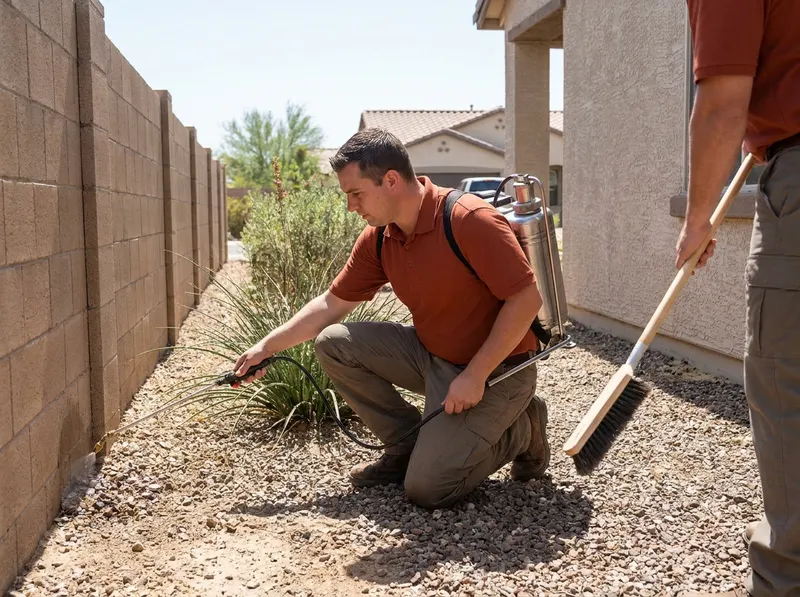
Bark scorpions in Phoenix are a construction problem as much as a pest problem. They do not burrow like desert hairy scorpions; they press themselves into existing voids, and the metro is built out of voids. Hollow block walls with open top courses, the weep screed gap at the base of stucco, the space behind a slab-on-grade expansion joint, roof tiles on a tile-and-foam roof, and the sleeve where a hose bib or A/C line set passes through the wall — those are the addresses scorpions use. Treating the yard without closing those openings moves scorpions around instead of keeping them out. That's why our sequence is inspect, seal, then treat, and why we hand you the entry-point list even on the first visit.
Pressure varies block by block across Phoenix. Homes in Ahwatukee Foothills that back the South Mountain Park and Preserve boundary sit against undisturbed desert with a permanent supply of scorpions and the crickets and small roaches they eat — those properties usually need ongoing exterior service, not a one-off. Newer stucco subdivisions in Laveen and Desert Ridge often show the opposite pattern: young landscaping, few insects, but pristine weep screeds and garage door corners that let scorpions walk straight in, so exclusion delivers most of the result there. Arcadia and Encanto-Palmcroft bring mature citrus, flood irrigation and deep leaf litter, which builds the insect base scorpions hunt; we spend inspection time on irrigation valve boxes, tree wells and block-wall alleys. In Maryvale the long shared block-wall alleys are the corridor, and in Moon Valley the granite boulders and rock ground cover near the Phoenix Mountains Preserve foothills near Piestewa Peak act as daytime cover within feet of the foundation.
Older central Phoenix housing is its own case. Bungalows in the Willo Historic District and Coronado Historic District often have raised foundations, original wood windows, crawl access, and decades of settling cracks — more openings, smaller openings, and more of them behind landscaping. Historic homes generally need more sealing labor and less chemical volume. Lofts and mixed-use buildings around Roosevelt Row see scorpions come in at ground-level thresholds and shared utility chases rather than roofs.
Decide between the two options this way. A one-time bark scorpion service fits a property with a single sighting, no desert interface, and a solid perimeter you're willing to seal — you get the inspection, the treatment, and the punch list, and you're done. A recurring exterior program fits homes against preserve land, on large lots, with flood irrigation, or with a history of repeat sightings; scorpions live two to six years and neighboring lots keep resupplying, so periodic exterior service holds the line the sealing created. The trade-off is honest: one-time service costs less today and can leave you re-treating on your own dime in eight weeks; a program costs more across the year and is the only version that reliably ends the cycle. A black-light inspection is also legitimately diagnostic — if we sweep the yard at 10pm and find nothing on the walls, we'll say so instead of selling you a plan.
Every number below is a ballpark for Maricopa County work. Exact price is confirmed on a free on-site visit, after we've walked the perimeter and counted the openings — not over the phone, and not changed once a technician is standing in your driveway. Ask us, or any Phoenix pest company, for the Arizona applicator license number and insurance details before anyone applies product at your home; that's a fair question and it should get a straight answer.
Every job gets a firm, written price after a free on-site visit.
Tell us about your bark scorpion control job in Phoenix and we'll send a clear, written quote — usually the same day.
 Nestleap Pest Control Service